

'Like an Exploding Bomb': Deadly Nepal Flooding Caused by Possible Glacial Fracture
August 27, 2026

Last updated 2:45pm EDT.
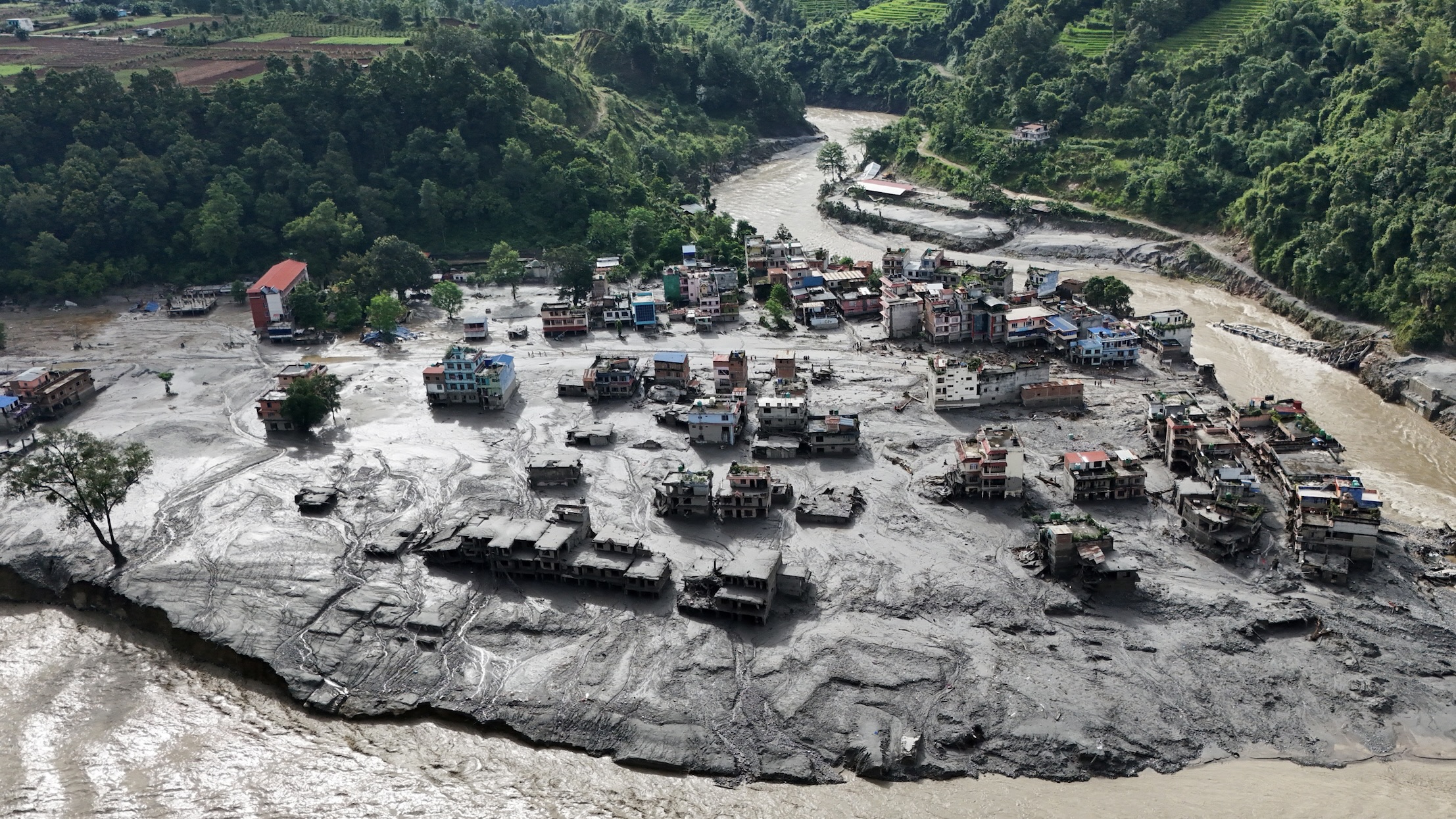
At least 390 people were killed by flash flooding along the Nepal-Tibet border on Wednesday. More than 1,400 people are still missing. Experts believe the flood was likely caused by a massive chunk of glacier breaking off into the Lhende Khola river.
Frightening videos showed a rolling wall of gray water slamming into a border checkpoint. The massive force of the water wall swept away cars, buildings, and people. Another clip revealed a bridge getting swept away in a matter of moments. Officials estimate that water levels along the river rose nearly 30 feet in under 30 minutes.
“It was a huge rise, a huge surge of water that happened suddenly,” Saswat Sanyal told The Associated Press (AP). He works for the International Centre for Integrated Mountain Development in Kathmandu.
The Nepal-Tibet border sits in the Himalayan Mountains. Early data suggests that a huge piece of ice sheared from one of the region's more than 63,000 glaciers. The massive ice chunk tumbled into the river. As it fell, it forced a great volume of water downstream. The impact was so strong it produced as much seismic energy as a 5.2-magnitude earthquake. That's from the US Geological Survey. Jakob Steiner compared the event to an exploding bomb. He's a geologist.
“A lower part of a glacier has really come off,” Steiner told the AP. “It’s like someone cut with a huge knife through the whole lower part and it fell off.”
Experts said it’s too early to say whether climate change is to blame. But they do note that rising temps make extreme events more likely.
"We have to be cautious and not draw a connection yet," Saswat said. But he did note that warmer temps have been melting the glaciers in the region. UN reports predict that the world could lose up to 80% of its glaciers by 2100.
Reflect: What helps you feel steady when something in the world feels sudden or out of your control?
Photo of the aftermath of the flash flooding in Nepal from Reuters.
News brought to you by 
Read More News Stories Today!